
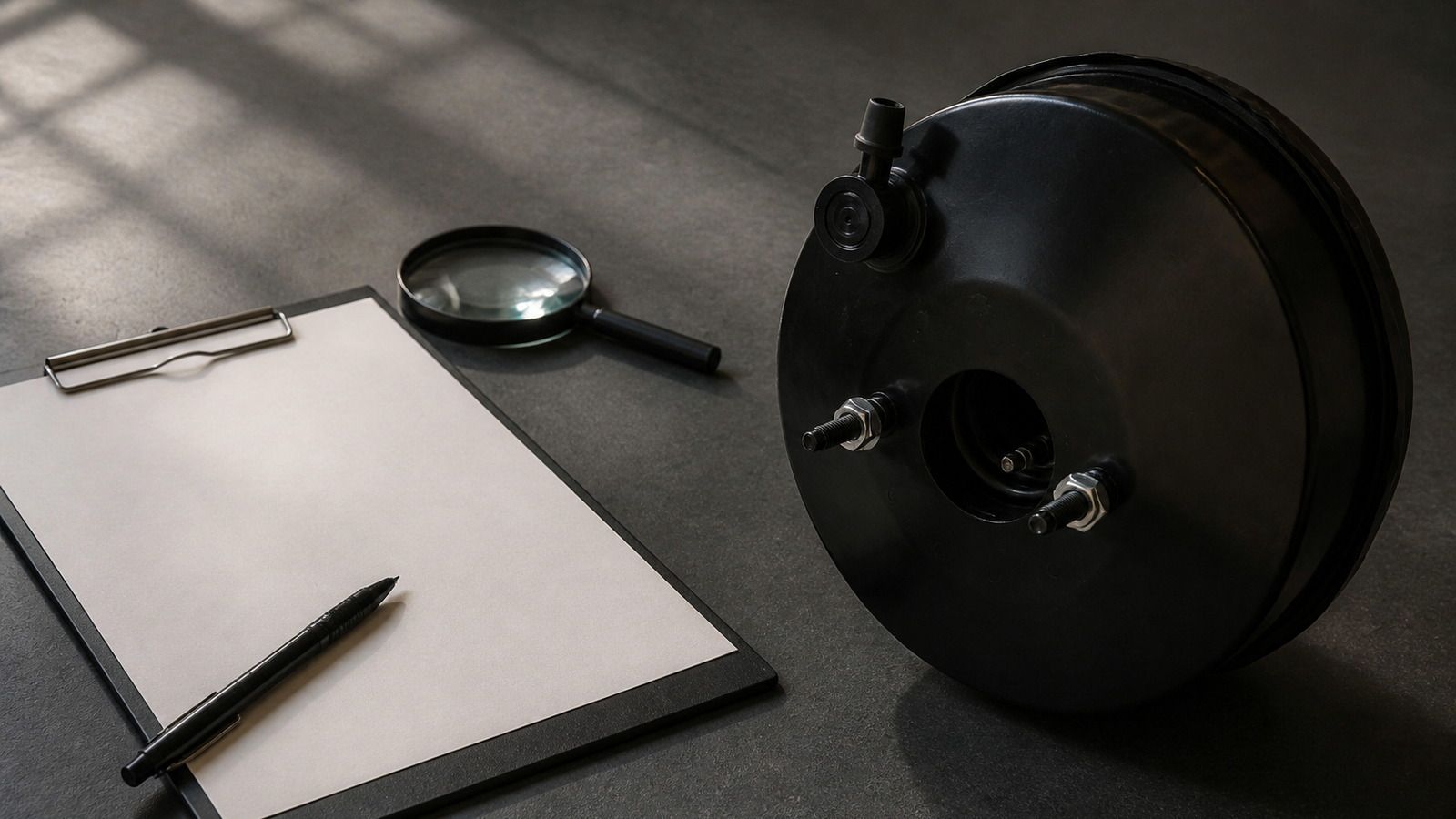
The short answer: verifying a Chinese brake parts factory takes three checks. The business license (is it a manufacturer or a trader?), the IATF 16949 certificate (number, validity dates, and the scope line almost nobody reads), and the factory itself (an on-site, third-party, or video audit). Do all three and you've filtered out most of the risk before a single dollar moves.
Picture this: you have a shortlist of five suppliers, quotes within 12% of each other, and a container to fill. Every website says "leading manufacturer." Every sales rep says "yes, we have IATF." One of them is a factory. Two are trading companies renting a showroom. One has a certificate that expired in 2023. From your desk in Hamburg or Houston, they look identical.
We know, because we sit on the other side of that desk. AODA Machinery (the factory behind the AOYIDA brand) has been making vacuum brake boosters since 1995, from the current Wenling, Zhejiang plant since 2003. For 31 years, importers, distributors, and their hired auditors have walked our floor, checked our licenses, and read our certificates line by line. This guide is the checklist we wish every buyer used, because the factories that survive it are the ones you actually want to buy from. It's one chapter of our complete guide to sourcing brake boosters from China; still building your shortlist? Start with how to find brake booster manufacturers in China, then come back here.
Key takeaways
- Verify the legal entity first. The business scope line is one of the strongest early signals, but a scope that says "manufacturing" still doesn't prove your part is made at that address.
- A real IATF 16949 certificate carries a certificate number, a site code (USI), validity dates and a scope. Check them with IATF Global Oversight and with the registrar named on the document. An empty lookup means "not yet verified", not "fake".
- A third-party audit costs less than most buyers assume: QIMA's public price list starts supplier audits in China at USD 669 per auditor-day, travel included. Get a current quote, and decide by risk rather than by order value alone.
- For brake boosters, ask the question generic guides skip: "Which characteristics are tested on every unit, which are sampled, and why?" Both belong in a real plan; you want to know which is which.
- The strongest trust signal is a factory that volunteers evidence before you ask, starting with its certificate number.
1. Verify the Business License: Manufacturer or Middleman?
Every legally registered company in China has a business license (营业执照), and its contents are public record. This is your first and cheapest filter: it costs nothing but ten minutes.
Ask the supplier for a scan of their license, then verify it yourself:
- National Enterprise Credit Information Publicity System (gsxt.gov.cn). The official government registry, showing registration status, registered capital, establishment date, legal representative and business scope. Search the company's exact Chinese name. Be warned: this portal is frequently unreachable from outside mainland China, and the commercial aggregators that republish it are often blocked too. Plan for that rather than treating a failed page load as a red flag.
- When the portals don't load from where you are (and they often don't) verify the entity another way rather than skipping the step:
- ask for an uncropped scan of the business licence and read the exact Chinese legal name and the 18-character Unified Social Credit Code off it;
- have that code checked by anyone with mainland access: a China-based lawyer, your bank's KYC desk, an audit firm, or your own sourcing office;
- on a video call, ask to see the original licence on the wall, the plant sign, and the street outside. It is cheap, and it ties the paper to a physical place;
- separately, map the relationships: which entity owns the plant, which one issues the invoice, which one holds the bank account, and which one owns the brand. Those are often not the same company, and that is where the surprises live.
Three things to read on the license:
- Business scope (经营范围). The line worth reading first. A manufacturer's scope lists activities like "制造" (manufacturing) of auto parts; a pure trading company's reads "批发" (wholesale), "零售" (retail) or "进出口" (import/export) with no manufacturing at all. Neither is illegal, and plenty of legitimate groups hold both. Two cautions: a scope that includes manufacturing does not prove your particular part is made at that address, and it is normal for a manufacturer to invoice and collect through an affiliated export company. If the website says "factory" and the licence says "wholesale only," you have a question that needs a straight answer. Ask which legal entity owns the plant, and get its licence too.
- Registered address. Does it match the factory address they gave you? A registered office in a city business district with a "factory address" elsewhere is worth a follow-up question.
- Establishment date. Twenty-year-old companies behave differently from two-year-old ones. The registry date, not the website's "est. 1998" banner, is the truth.
From the factory floor: when buyers audit us, the license check takes them minutes: AODA Machinery's registration, scope, and 2003 establishment date are public record. If a supplier hesitates to send a license scan, that hesitation is data.
2. Verify the IATF 16949 Certificate: Number, Dates, and the Scope Line Everyone Skips
For safety-critical parts like brake boosters and master cylinders, IATF 16949 is the automotive quality management standard that matters. It's also the most abused claim in supplier marketing. Here's how to verify an IATF 16949 certificate online in under five minutes.
Step-by-step verification
- Ask for the full certificate PDF. Not a logo on a homepage. The actual document, uncropped. Most organised suppliers send it quickly; a delay is worth a follow-up, not a verdict.
- Find the IATF certificate number. Typically a 6- or 7-digit number printed on the certificate, plus the site's Unique Site Identifier (USI).
- Go to the IATF Customer Portal (iatf-customerportal.org) and use the certificate validity check. Enter the IATF number or USI. The portal returns the certificate status: "issued" means active; "suspended" or "withdrawn" means stop and ask hard questions; no result means the number doesn't exist.
- Cross-check the certification body. Only IATF-recognized certification bodies can issue valid certificates. The list is maintained by IATF Global Oversight (iatfglobaloversight.org). A certificate from an unrecognized "institute" is decoration.
- Check it with the bodies that issued and govern it. IATF certificates carry an IATF certificate number and a site-level Unique Site Identifier (USI). Use both against the IATF Global Oversight certificate validity check, and confirm the registrar named on the certificate is itself IATF-recognised. If a search returns nothing, that is not proof the certificate is fake: input format, USI-versus-certificate-number confusion, and database lag all produce empty results. The correct move is to suspend acceptance and confirm with the issuing body directly, using contact details you obtained independently rather than from the supplier. China's national registry (cnca.gov.cn) is a useful cross-check, though its certificate-search subdomain is often unreachable from abroad.
The three elements that matter
| Element | What to check | Red flag |
|---|---|---|
| Certificate number | Returns "issued" on the IATF portal | No number, or no result found |
| Validity dates | Current date falls inside the validity window | Expired, or "renewal in progress" for months |
| Certification scope | Covers the product and process you're buying | Scope covers a different product, or nobody mentions scope at all |
That third element is where most buyers stop too early. An IATF certificate is not a blanket badge of quality. It certifies specific processes at a specific site, spelled out in one scope sentence. A factory can hold a genuine, in-date certificate whose scope has nothing to do with the part you're ordering.
A worked example of a scope line. A vacuum-booster plant's certificate might read: "Manufacturing of Vacuum Booster (Excludes Product Design under Clause 8.3)". Read it twice. It covers the manufacture of vacuum boosters. It excludes product design under Clause 8.3. That means the certified system covers production processes, not design responsibility, and it says nothing at all about master cylinders or hydraulic boosters made in the same building.
So if you are buying master cylinders from that plant, its IATF certificate does not cover the part you are ordering. That is not fraud on the supplier's part; it is a scope boundary that most buyers never read. Ask which processes and which product families the scope actually names, and ask for the certificate itself rather than a logo on a brochure.
Ask any supplier, including us, for three things: the certificate number, the site code (USI), and a photograph of the scope line. A factory that has them will send them. A factory that answers with a logo instead of a number is telling you something.
3. Audit the Factory: Three Options Compared
Paperwork verifies the company. An audit verifies the building. You have three options:
| On-site visit | Third-party audit (SGS, QIMA, Bureau Veritas) | Live video audit | |
|---|---|---|---|
| Cost | Your travel + 1–2 days | Public list prices start at USD 669 per auditor-day in China, travel included | Free (a video call) |
| Depth | Highest: you see everything, unscripted | High: standardized report, photos, professional checklist | Medium: you direct the camera in real time |
| Best for | High-risk or long-term programs | Most first-time verifications | Shortlisting, follow-ups, pre-audit screening |
| Limitation | Expensive at scale | You interpret a report, not the floor | Supplier controls the route; insist on calling the shots |
A few practical notes:
- Third-party audits are direct-bookable. You can hire QIMA, SGS, or Bureau Veritas yourself. No sourcing agent required. QIMA publishes its list price: supplier audit programs in China from USD 669 per auditor-day, with the auditor's transportation, meals and accommodation included; get a current quote for your actual scope and duration rather than budgeting from a list price. Decide whether to spend it on risk, not on order value alone: how safety-critical the part is, how hard the supplier would be to replace, and what your own customers require.
- On a video audit, you choose the path. Ask them to walk from raw material storage → machining → assembly → testing → packing, live, no cuts. Pre-recorded "factory tour" videos prove nothing.
- A factory's reaction is the audit before the audit. "Of course. When suits you?" is the right answer. Delays, excuses, or "our workshop is under renovation this month" are answers too.
From the factory floor: a European distributor once asked, mid video call, if we could walk to the test area right now and run a booster through the bench while he watched. We did. It's the kind of request we like, because it takes five minutes and it's hard to stage. When you video-audit us, drive the call the same way. We have customers on site regularly, so the walk is a normal one. Ask for the bench, ask for a unit to be run while you watch, and ask to see the record it writes.
4. Trading Company vs Factory: The Identification Matrix
Trading companies are not villains. A good one consolidates SKUs, handles export paperwork, and earns its margin. The problem is not knowing which one you're talking to, because the price structure, engineering depth, and accountability chain differ completely. Run every candidate through this matrix:
| Signal | Factory | Trading company |
|---|---|---|
| Business license scope | Contains "manufacturing" (制造) | "Wholesale / import-export" only |
| Engineering questions | Answers pushrod dimensions, diaphragm materials, test pressures from the floor | "Let me check and get back to you", then relays someone else's answer |
| Video tour | Walks the line live, anytime | Shows a showroom; the "workshop" tour needs scheduling |
| Product range | Deep in a few categories (e.g., brake hydraulics) | Everything from brake pads to wiper blades |
| Quote behavior | Quotes from BOM and process cost | Adds a margin layer to a factory's quote |
| Customization / OE matching | Modifies tooling, confirms fitment against OE numbers | Limited to what their source factory offers |
| Export market references | Names regions and long-term customers directly | Vague "we export worldwide" |
Several of these at once doesn't convict anyone. It tells you the evidence is thin, and exactly where to push. Ask who owns the plant, at which address the part is machined and assembled, and whether they'll show you work in progress against a named order. An intermediary in the chain is not automatically a problem; an intermediary you didn't know about is.
From the factory floor: apply this matrix to us. AODA Machinery makes four product lines: vacuum boosters, brake master cylinders, hydraulic boosters, clutch boosters. All brake hydraulics, nothing else. Our catalog carries 1,000+ developed part numbers, 13,767 fitment records, and 2,334 unique reference numbers, all searchable in our online catalog. Send our sales team a pushrod length question and watch how fast the answer comes back. That's the test we'd use on us.
5. Brake-Parts-Specific Checkpoints Generic Guides Can't Give You
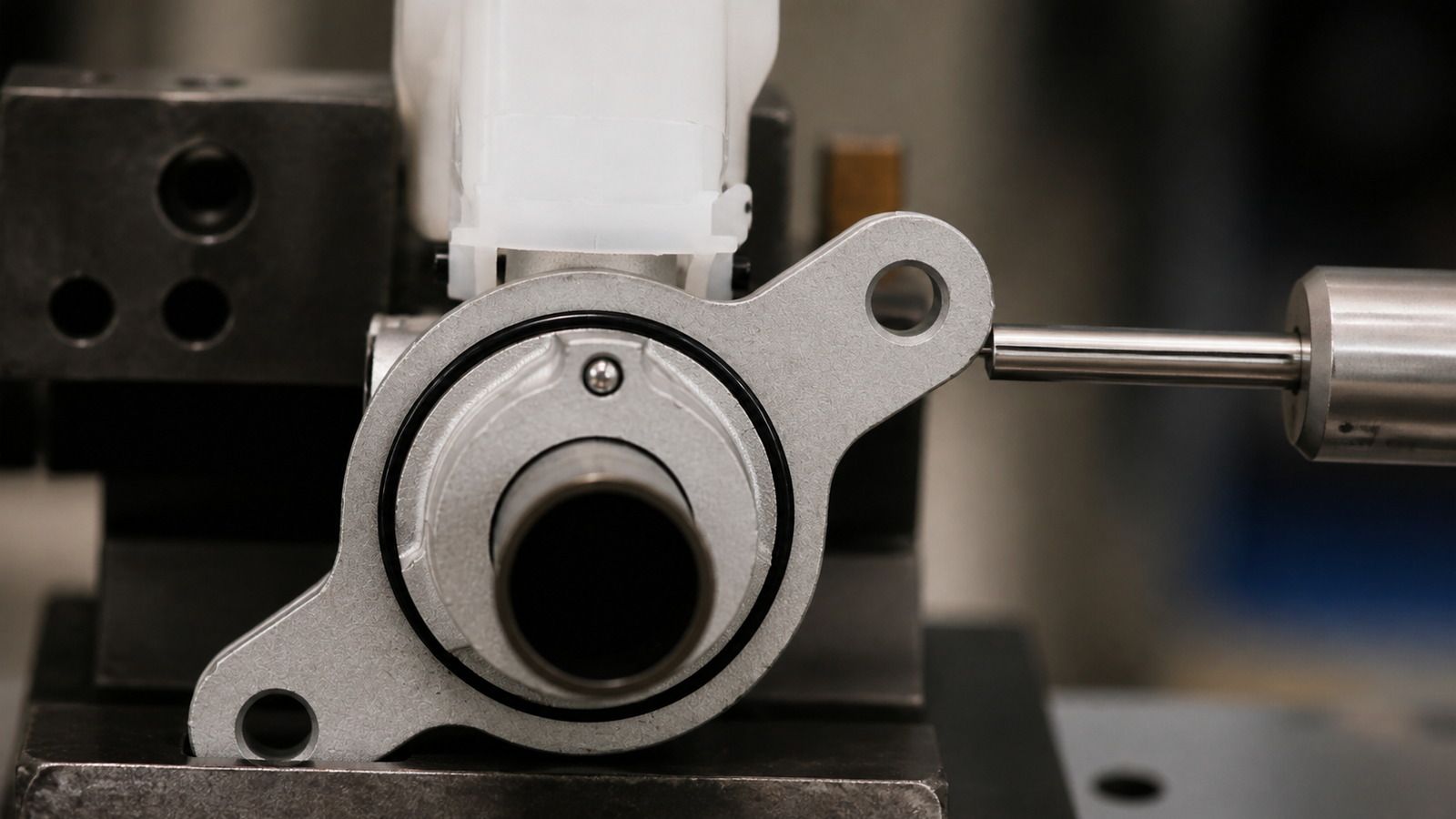
Every sourcing guide tells you to "check quality control equipment." Almost none tell you what that equipment is for a brake booster. Here's the floor-level version:
- The end-of-line bench. What is tested on every unit, and what is sampled? A vacuum booster that leaks is a brake-assist failure waiting for mileage, so ask which characteristics are treated as critical and tested on every unit, and which are sampled. Both belong in a sound plan; what you want to know is which is which here, and why. Then ask to see the test record format.
- What a pass/fail looks like. On our line, every booster goes on the characteristic tester before packing. Idle seal, seal below and above the boost point, and the full input-to-output force curve, judged automatically against preset limits and saved with the product code and a timestamp. You can watch that bench running on our About page. What you're testing when you ask this question is not whether the answer is "100%". It's whether the person can tell you which characteristics are on every unit, what the limits are set against, when the gauge was last calibrated, and what happens to a unit that fails. Someone who shows you the rig and the record answers all four without preparation.
- Pushrod and valve-body adjustment. Ask how output pushrod length is set and verified. It's a dimension that decides whether the booster plays correctly with the master cylinder, and sloppy factories treat it as approximate.
- Assembly performance testing. Beyond leak: reaction force, input-output characteristic curves, sealing of the vacuum check valve. A serious factory tests the assembly as a system, not just its components.
- Traceability. Pick a finished unit and ask: "Show me this unit's production batch and test record." Laser-marked batch codes plus retrievable records = a real system. A shrug = a parts assembler.
(Verification doesn't end at the audit, by the way. Once you're ordering, managing batch quality and pre-shipment inspection is the next layer. A dedicated guide is in preparation.)
6. Red Flags: Walk Away When You See These
- Won't send the business license or sends a photo cropped to hide the scope line.
- "We have IATF" but no certificate number, or a number that returns nothing on the IATF portal.
- Certificate scope doesn't match your product, and the sales rep didn't know certificates have scopes.
- Registered address ≠ factory address, unexplained.
- Quotes 40–50% below every other supplier. Material and process costs for a given booster don't vary that much; something was removed from the part.
- Video tour keeps getting postponed, or only pre-recorded footage is offered.
- Can't answer a basic engineering question (pushrod length, test pressure, diaphragm material) within one working day.
- Refuses third-party inspection as a condition of the order. Any confident factory treats SGS/QIMA visits as routine.
7. The Inversion: What a Professional Factory Volunteers
Most guides teach you to defend against factories. Flip it: the best factories make verification easy because verification is their sales pitch. Here's what a professional brake parts factory hands over before you ask:
- Business license scan, unprompted and uncropped.
- IATF 16949 certificate with the number visible and the portal link to check it.
- A live video tour on your schedule, walking the route you choose.
- Test process documentation. What is tested, at what parameters, 100% or sampled, with records.
- Export market references. The regions they ship to and how long customers have stayed.
- An open door for your auditor. Third-party inspection written into the process, not tolerated as an insult.
We wrote this checklist from 31 years of being on the receiving end of it. Buyer audits, bank questionnaires and third-party inspections across six market regions since 2003. Everything on it, we answer ourselves. That's the point of this article: use every step above to audit us. Check our registration with the Chinese company registry. Ask us for whatever certification documents you need and verify each one with the body that issued it, not with us. Book a video call and walk our leak-test bench. Ask our engineers something hard.
Conclusion: Trust Is a Verification Result, Not a Sales Claim
Verify the license and you know who they are. Verify the IATF certificate (number, dates, scope) and you know what an independent auditor has confirmed. Audit the floor and you know how they actually build. The factories worth your container are the ones that make all three easy.
Your next step: pick the most promising supplier on your shortlist and run Section 2's five-minute IATF check on them today. And if brake boosters, master cylinders, or hydraulic boosters are on your RFQ, send us your OE number or browse our catalog and run this checklist on us: entity, site, samples, first article. We'd rather be verified than trusted.
This article is one chapter of our complete guide to sourcing brake boosters from China. See the full eight-stage sourcing workflow, from finding suppliers to pre-shipment inspection.
FAQ
How do I verify an IATF 16949 certificate online? Get the full certificate from the supplier and read two identifiers off it: the IATF certificate number and the site-level Unique Site Identifier (USI). Run both through the certificate validity check published by IATF Global Oversight, and confirm the registrar named on the certificate is itself IATF-recognised. Check that the status is current, the dates are valid, and (critically) that the scope line covers the product you are buying. If the lookup returns nothing, don't conclude the certificate is fake; suspend acceptance and confirm with the issuing body using contact details you found independently.
What is the difference between IATF 16949 and ISO 9001 for brake parts? ISO 9001 is a general quality management standard. IATF 16949 builds on it with automotive-specific requirements. Traceability, defect prevention, production part approval, and for safety-critical parts like brake boosters it should be treated as the baseline, not a bonus.
How much does a factory audit in China cost? Less than most buyers expect. QIMA's public price list starts supplier audits in China at USD 669 per auditor-day with travel included, and most general audits take one day; ask SGS or Bureau Veritas to quote the same scope. A live video audit costs nothing and catches most problems during shortlisting.
Is a trading company always worse than a factory? No. Good traders add value in consolidation and export handling. The risk is paying factory prices to an undisclosed middleman. Use the business license scope line and the identification matrix above so you always know which one you're dealing with.