
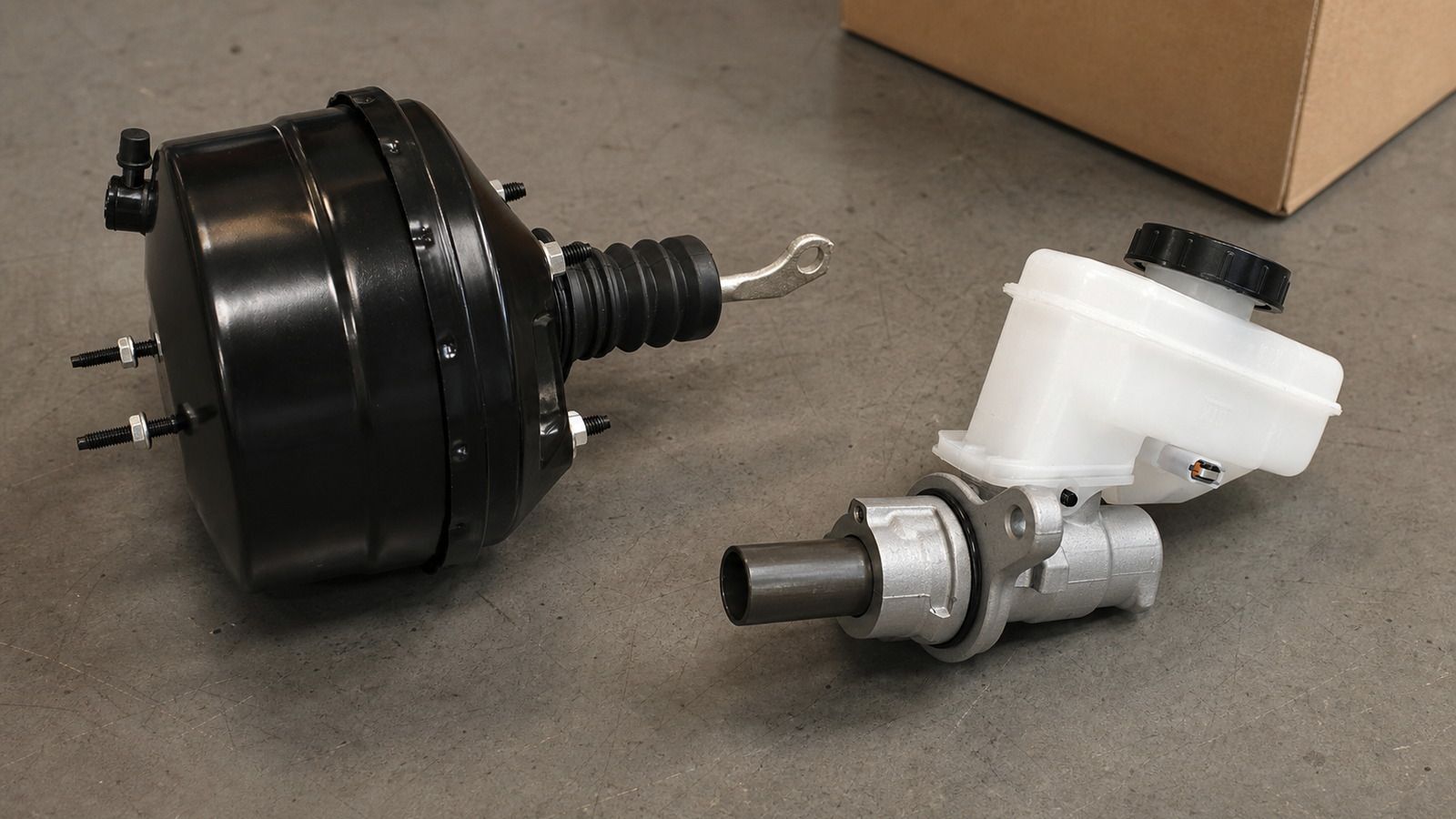
You have an OE number, a target price, and a container to fill. What you don't have is certainty.
Here's the certainty, compressed: sourcing brake boosters from China safely is an eight-stage process. Know the part, find manufacturers, shortlist, verify the factory, confirm fitment, negotiate terms, control quality, and plan the timeline. Each stage has its own discipline, and each can be done from your desk until the audit. Skip a stage and the risk doesn't disappear; it just moves to your warehouse, inside sealed boxes.
If you've sourced from China before, you know the paradox: the world's deepest brake hydraulics supply base and its most convincing storefronts share the same search results. This guide is the map through both. Each stage below gets a working summary, and the stages that deserve their own guide link out to one.
One disclosure up front: this guide is written by a factory that has been on the receiving end of buyer audits for 31 years. AODA Machinery (the factory behind the AOYIDA brand) has manufactured vacuum brake boosters in Wenling, Zhejiang since 2003. We wrote the map we wish every buyer arrived with, because buyers who follow it are the easiest ones to work with.
Key takeaways
- Sourcing a brake booster from China is eight sequential stages; a realistic first order runs 4–5 months from first email to delivered container.
- Three inputs decide how firm a quote can be: the reference number, the target vehicle list, and the annual volume. With all three you can get a production quote; with fewer you can still get a budgetary one, as long as both sides say which kind it is.
- Verification is three checks: the legal entity, the IATF 16949 certificate (number, site code, dates, scope), and the factory itself. Check the certificate with the body that issued it, not with the logo on the homepage.
- "Fits" is not "performs": fitment confirmation means OE cross-references plus physical samples, never a catalog picture.
- The most revealing question in booster sourcing: "Which characteristics do you test on every unit, which do you sample, and what happens to a unit that fails?"
1. Know What You're Buying: Booster Types and the Numbers That Matter
Sourcing goes wrong earliest at the specification stage. A buyer who can't describe the part gets quoted on whatever the supplier feels like making.
This guide covers the two booster families we build. (Electric brake boosters and integrated electro-hydraulic brake systems are a separate sourcing conversation, with a different supplier base.) Vacuum boosters dominate passenger cars: a diaphragm, a vacuum source, a control valve. Single- or dual-diaphragm (tandem) layouts, sized by shell diameter. Hydraulic boosters serve vehicles without manifold vacuum to spare (diesels, turbos, some trucks) driven by hydraulic pressure. They source differently: different factories, different test rigs, different failure modes. Know which family your program needs before you open a search bar.
The three numbers every RFQ needs
- The OE number. The original part number stamped on the unit you're replacing. It anchors everything: cross-references, fitment, price benchmarking.
- The target vehicle list. Makes, models, years, and markets. "Toyota Hilux" is not enough; which Hilux, which years, sold where.
- The annual volume. Factories price, schedule, and decide on tooling around volume. An estimate or a range is fine; "it depends on the price" tells the factory there is no program behind the enquiry yet.
Be explicit about which quotation you are asking for, because they are not the same document:
- a budgetary quotation: indicative pricing from a reference number and a rough volume, useful for market testing;
- a production-intent quotation: firm pricing tied to a confirmed application, packaging and Incoterm;
- a tooling quotation. Where the part is not in production anywhere and development cost has to be amortised.
New-development parts often start from a drawing or a physical sample rather than a number at all. That is normal. What causes weeks of email ping-pong is not the missing data. It is nobody saying which of the three documents they are actually asking for.
From the factory floor: an RFQ with these three numbers gets a real answer from us fast. Fitment confirmed against our 2,334 unique reference numbers and 13,767 fitment records, a quote, and a sample plan. An RFQ without them starts a week of email ping-pong. See the data depth yourself: search our catalog by OE number.
2. Where to Find Brake Booster Manufacturers
Four channels, used together:
- B2B platforms (Alibaba, Made-in-China, Global Sources): filters, not directories. Search by OE number, not product name, and read badges for what they actually verify.
- Trade shows: exhibitor lists from Automechanika Shanghai and Canton Fair Phase 1 are free, self-selected lead pools. Exhibiting costs real money, which filters for you.
- The Zhejiang cluster: China's brake hydraulics concentrate in the Wenling–Yuhuan–Rui'an coastal corridor; Yuhuan alone hosts 4,000+ auto parts manufacturers (China Daily). A factory address on this belt is a genuine screening signal.
- OE reverse-lookup: search the OE number itself; the suppliers who surface with cross-reference data have engineering depth a storefront can't fake.
📖 Deep dive, Chapter 1: How to find brake booster manufacturers in China (beyond Alibaba listings). Platform badge decoding, trade-show mining, the cluster map, and the screening funnel from 50 names to 5.
3. Shortlisting: From 50 Suppliers to 5
Expect 30–50 candidate names from the channels above. Four criteria cut them to five in about a week of desk work:
| Criterion | Pass looks like | Fail looks like |
|---|---|---|
| Category focus | Brake hydraulics only | Boosters next to wiper blades and phone mounts |
| Capacity fit | Your volume is meaningful but routine to them | A 20-person shop, or a giant where you're a rounding error |
| Export markets | Names your region and its norms | "We export worldwide," no specifics |
| Response quality | Technical answers within ~24h | Price-first replies; "let me check" for three days |
One boundary: a shortlisted name has earned verification, not passed it. That's the next stage.
4. Verifying the Factory: Certificates, Audits, Red Flags
Three checks, in order of cost:
- Business license. China's enterprise registry is public; the business scope line tells you whether you're talking to a manufacturer (制造) or a trading company (批发/进出口). Neither is illegal, but you should know which one you're paying.
- IATF 16949 certificate. For safety parts, this is the baseline quality standard, and the most abused claim in supplier marketing. Verify the certificate number on the official IATF portal (iatf-customerportal.org), check the validity dates, and read the scope line. The certificate covers specific processes at a specific site, nothing more.
- Factory audit. On-site visit, third-party audit (SGS, QIMA, Bureau Veritas; QIMA's public list price for China starts at USD 669 per man-day, travel included), or a live video audit where you direct the camera. For boosters, add the question generic guides never mention: does every unit pass a vacuum leak test, or only samples?
From the factory floor: run these checks on us first. Ask us for the certificate number, the site code and a photograph of the scope line, and check them against the issuing body's own register before you take our word for anything. A factory's reaction to an audit request is the audit before the audit.
📖 Deep dive, Chapter 2: Verify a brake parts factory before you order. The full license check, the five-minute IATF verification walkthrough, audit options compared, the trader-vs-factory identification matrix, and the red-flag list.
5. Confirming Fitment: OE Cross-References and Samples
A supplier says "yes, we make this OE number." That sentence is the beginning of fitment confirmation, not the end.
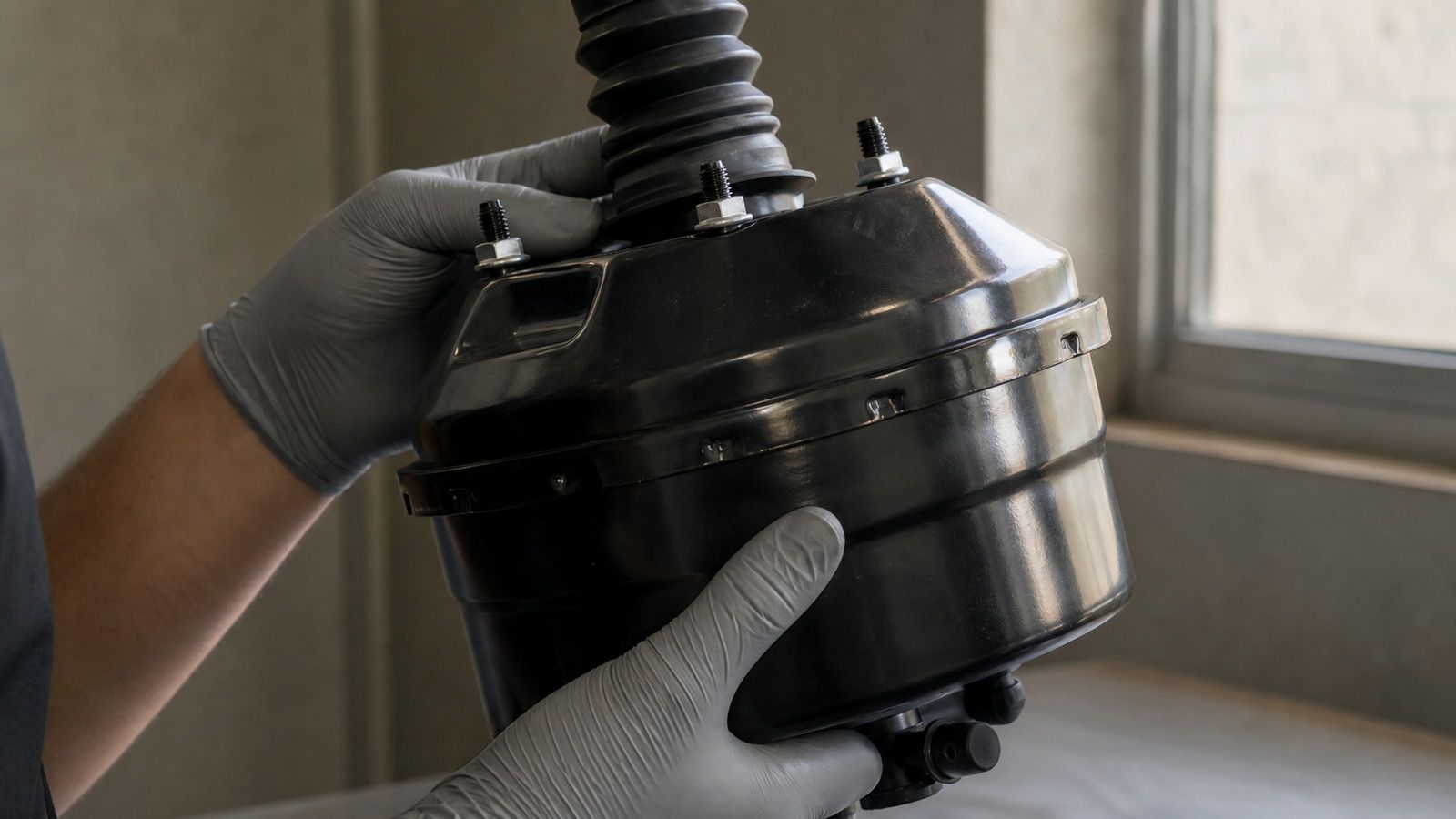
Cross-reference data tells you what should match; physical samples tell you what does. The differences that matter are dimensional: output pushrod length, shell diameter, vacuum port orientation. A unit can bolt on and still deliver the wrong assist curve. So request samples. How many depends on what you need to do with them. One or two is enough for fit and dimensional checks; more if you intend to destroy some, if the SKU has variants, or if your approval process needs retained samples on both sides. Compare against your old part side by side, and bench-test before approving anything for bulk.
6. Negotiating Commercial Terms: MOQ, Pricing, Tooling, Payment
Four moving parts:
- MOQ. Minimums are driven by line changeover, casting runs and whether the item is already in stock, so they vary widely, and a low one is not automatically a warning. Ask why the number is what it is. A supplier who can explain the changeover behind it is telling you more than the number itself does. Ours vary by part and by whether tooling and stock already exist; ask us for the specific SKU. Mixed-SKU consolidated container orders are welcome.
- Pricing. A factory price is material + machining + assembly + testing + packing + export costs, under a stated Incoterm. When a quote sits far below the rest of the field, don't assume theft of material. Ask for it split into those lines, plus the Incoterm and what testing is included. Sometimes the gap is a different scope, a different delivery term, or existing stock. Sometimes it is exactly what you feared. The breakdown tells you which.
- Tooling. If your OE number isn't in production anywhere, new tooling has a cost and an amortization math, worth it only above a volume threshold. First question to ask any factory: "Is this already in your tooling library?" (1,000+ developed part numbers means most inquiries to us need no new tooling at all.)
- Payment. A frequently used first-order structure is a 30–50% deposit with the balance released against an agreed trigger. Goods ready, a passed pre-shipment inspection, or copy documents. Write the trigger into the contract; "balance before shipment" and "balance against inspection release" are very different risks. Letters of credit add bank fees and paperwork in exchange for bank-enforced terms. Match the instrument to the order size and to the trust you've built in Stage 4.
7. Quality Control and Pre-Shipment Inspection
Verification ended at the audit; quality control runs for the life of the relationship. The frame is three gates: incoming materials, in-process checks, and pre-shipment inspection.
For boosters specifically, ask about the test list: vacuum leak-down, check-valve sealing, input-output characteristics, pushrod setup. Then ask how each one is controlled, and here, resist the framing that 100% end-of-line testing and sampling are alternatives. A sound plan uses both, on different things:
- 100% functional testing on the defined critical characteristics, at end of line, with the result recorded;
- process control on key dimensions: first- and last-piece checks, in-process gauging, SPC where it earns its place;
- risk-based sampling for what cannot be tested on every unit: material, endurance, salt spray, and for appearance, packaging, labelling and count;
- measurement discipline underneath all of it. Calibration, gauge capability, and a written reaction plan for a fail.
Sampling answers the question "do I accept this lot?", and it carries both producer's and consumer's risk by design; it never proves a lot is defect-free (NIST). That is precisely why the critical characteristics get tested on every unit instead. Third-party pre-shipment inspection should be welcomed in the contract, not negotiated around.
From the factory floor: every booster on our line goes on the characteristic tester before packing. Idle seal, seal below the boost point, seal above the boost point, and the full input-to-output force curve. The tester judges each unit against preset limits and saves the result with the product code and a timestamp; those tests are tied to the production batch that ships. You can see the bench running and one of those saved readouts on our About page. When a buyer's inspector visits, that's the first station we walk to, because it's the one we'd ask to see.
8. The Sourcing Timeline: A Realistic First Order
As a planning example from our side of the table, a first production order shipped by sea runs 4–5 months when nothing goes wrong. Projects that start from approved stock, ship by air, or ride on an existing tooled program can be a great deal faster: the timeline below is a default to plan against, not a floor that every supplier must respect:
| Weeks | Stage |
|---|---|
| 1–2 | RFQs out, quotes in, shortlist built |
| 3–4 | Verification: license, IATF check, video or third-party audit |
| 4–8 | Samples produced, shipped, bench-tested, approved |
| 8–12 | Terms finalized, deposit, production slot |
| 12–16 | Production run + pre-shipment inspection |
| 16–20 | Ocean freight, customs, delivery |
Reorders compress to 6–10 weeks once tooling, terms, and trust exist. Anyone promising a first container in four weeks has deleted stages you needed.
Conclusion: The Map Is the Method
Sourcing brake boosters from China stops being a gamble the moment it becomes a sequence: spec the part with three numbers, find manufacturers through four channels, cut 50 names to 5, verify license and IATF certificate and floor, confirm fitment with cross-references and physical samples, negotiate terms that match the trust you've built, and inspect before anything ships. Five companion guides are live: finding manufacturers, verifying the factory, cross-referencing part numbers, private label and OEM/ODM programs and sourcing hydro-boost units, all written by the same people who run the process daily.
The fastest first step takes one minute: take the OE number off the part in front of you and send it to us. Send us your OE number or browse 1,000+ models in our catalog. Fitment confirmed against 2,334 unique reference numbers. And hold us to every standard in this guide. We'd rather be verified than trusted.
FAQ
How long does it take to source brake boosters from China? A realistic first order takes 4–5 months end to end: roughly two weeks each for quoting and verification, about a month for samples, a month for production, and four to five weeks for ocean freight and customs. Reorders from an established supplier compress to 6–10 weeks.
What is a normal MOQ for brake boosters from a Chinese factory? It varies by part number, by whether tooling and stock already exist, and by how much line changeover the run costs. Ask the supplier to explain the driver behind their number rather than comparing MOQs across quotes. A low minimum on an item already in stock means something quite different from a low minimum on a part that needs a dedicated run. If your volume per SKU is small, ask whether the factory consolidates several SKUs into one container; we do.
Do I need IATF 16949 for aftermarket brake parts? It is not legally required for aftermarket sales in most markets. What it does certify is the quality-management system at a named site, within a stated scope. It is not a product approval, it does not certify any individual SKU, and it does not replace part-specific validation. Our own view is that a safety-critical part deserves that baseline; that is our purchasing opinion, not a legal requirement. Ask the supplier for its current documents, then verify the certificate number, site code, validity dates and scope with the issuing body rather than accepting a logo.
Does it matter whether I buy from a factory or a trading company? A good trading company adds real value in consolidation and export handling. The risk is paying factory prices to an undisclosed middleman. Check the business license scope line so you always know which one you're dealing with, and price accordingly.