
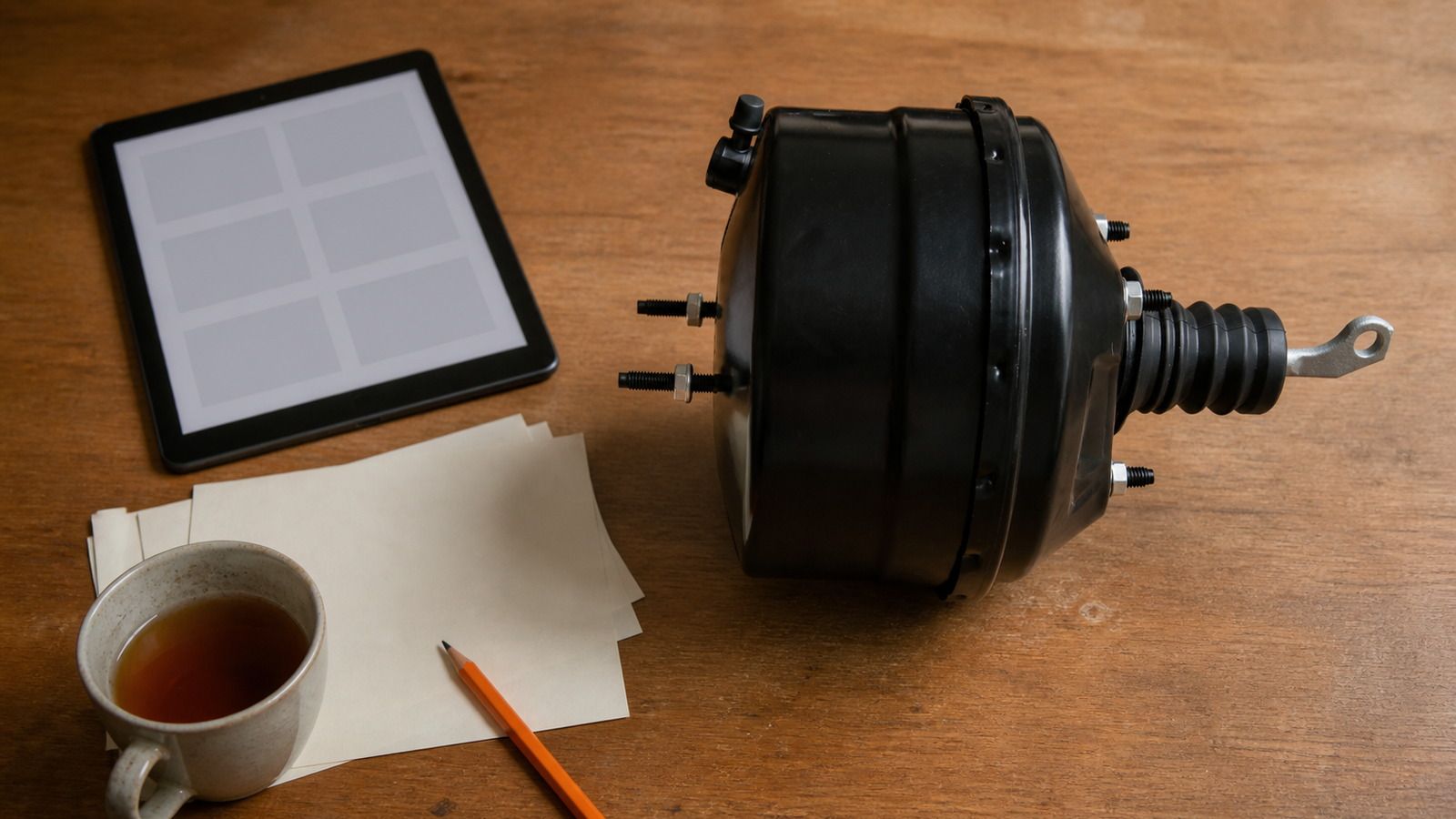
The short answer: to find brake booster manufacturers in China, start on B2B platforms but search by OE number instead of product name, filter for third-party-verified suppliers, cross-check candidates against trade show exhibitor lists, weight factories located in Zhejiang's brake hydraulics cluster. Then screen 50 names down to 5 with the checklist in Section 5. The whole process takes one to two weeks of desk work.
Consider Marcus (a composite of buyers we've watched do this) who runs a parts distribution business outside Rotterdam. Last year he typed "brake booster manufacturer China" into a platform search bar and got thousands of near-identical listings, every one claiming "factory direct, high quality." He sent a batch of inquiries on a Monday. By Friday he had replies with prices spread nearly threefold for the same OE number, and fewer than half of the "factories" could tell him a pushrod dimension. The listings told him nothing. The replies told him everything.
If you've done this yourself, you know the feeling: the problem isn't a shortage of Chinese brake booster suppliers. It's that every channel mixes factories, traders, and resellers into one undifferentiated pile. This guide pulls signal out of that pile: what platform badges actually verify, which trade shows matter, why a Zhejiang town you've never heard of is a screening tool, and how an OE number works as a metal detector.
Full disclosure before we start: AODA Machinery (the factory behind the AOYIDA brand) has made vacuum brake boosters since 1995, manufacturing them in Wenling, Zhejiang since 2003. We've spent 31 years on the receiving end of these searches, watching how buyers find us and which of them end up at the right factory. This article is one chapter of our complete guide to sourcing brake boosters from China.
Key takeaways
- Treat B2B platforms as filters, not directories: badges like Verified Supplier and Audited Supplier tell you what was checked, never what to conclude.
- Search by OE number, not product name. It pre-filters trading companies faster than any badge.
- Southern Zhejiang, and Yuhuan in particular, is a major automotive-parts cluster: Yuhuan alone hosts 4,000+ auto parts manufacturers. Location is background on the supply chain, not a verdict on any one supplier.
- Trade show exhibitor lists (Automechanika Shanghai, Canton Fair Phase 1) are free, self-selected lead lists, minable without attending.
- Screen 50 candidates down to 5 on four criteria: category focus, capacity fit, export markets, response quality. Treat "Top 10 manufacturers" listicles as raw lead lists, never as conclusions.
1. B2B Platforms: Use Them as Filters, Not Directories
Alibaba, Made-in-China, and Global Sources are where most buyers start, and that's fine. The mistake isn't using them. It's reading them like a directory of vetted factories, when they're really a search engine with optional verification layers.
Alibaba: biggest pool, heaviest noise
Three labels matter (Alibaba's own definitions):
| Badge | What it actually means | What it doesn't mean |
|---|---|---|
| Gold Supplier | Paid membership; the company was verified as a registered business | That it manufactures anything |
| Verified Supplier | A third party (SGS, TÜV, Bureau Veritas) assessed production capability on-site | That the assessment covered your product, or is recent |
| Trade Assurance | Orders placed and paid through the platform get shipment/quality dispute protection | Protection for deals closed over email or WeChat |
The Verified Supplier filter plus the "years as supplier" counter is a reasonable first pass. Understand what it does and does not mean: the platform has assessed a business, not certified that this company manufactures the part you need. Trading companies with genuine offices and good photography pass it easily. Treat the badge as a screening signal that narrows the list, never as proof of manufacturing.
Made-in-China: smaller pool, deeper industrial bench
Made-in-China skews toward machinery and industrial parts, and its Audited Supplier program has run since 2007 with on-site audits by SGS, Bureau Veritas, TÜV Rheinland, and CTI (program details). The useful part: the audit reports are free to read, covering manufacturing capacity, quality control, and R&D. Read the report, don't just note the badge. Our experience on Alibaba vs Made-in-China for brake parts: Alibaba gives you more names, Made-in-China more information per name.
Global Sources and the rest
Global Sources is tied to its Hong Kong trade shows and strongest in electronics; for brake hydraulics its pool is thinner. Beyond the big three, treat any brake parts factory directory (EC21, aggregators, association lists) the same way: a source of names, not a source of trust.
Four tactics work on every platform:
- Search by OE number, not product name. More in Section 4: the highest-leverage trick in this article.
- Check product-range coherence. A "manufacturer" listing brake boosters next to wiper blades and phone mounts is worth a question, not a conclusion. Group companies and specialist makers with several lines both exist. Most dedicated brake-hydraulics plants are boringly narrow: boosters, master cylinders, wheel cylinders, maybe clutch hydraulics. A wide catalogue means ask which items they make themselves and at which address.
- Read the response, not the listing. Send one technical question: output pushrod length, diaphragm material, test pressure. A specific, confident answer tells you someone with engineering access is on the other end. A slow or vague answer is not proof of a trading company. Factory sales often wait on engineering, and some trading firms keep resident engineers, but the quality of the answer is one of the cheapest signals you can collect.
- Note the registered location. You'll see why in Section 3.
The candid version: platforms are where a lot of buyers first meet a Chinese factory, and that is fine as a starting point. The ones who end up placing good orders do the same thing every time. They take the name off the listing, go to the company's own site, check whether the catalog data holds up, and verify the legal entity directly. Do that to us too. Start now: search our catalog by reference number and compare the data depth against any listing you've opened today.
2. Trade Shows: The Self-Selecting Lead List
Trade shows do one thing platforms can't: exhibiting costs real money. A booth, freight for samples, a week of engineers on concrete. Companies that do this yearly are established enough to afford being found. Exhibitor lists are a pre-filtered supplier pool, even if you never get on a plane.
Three shows matter for brake parts sourcing:
- Automechanika Shanghai. The one that counts for export-focused Chinese parts factories. The 2025 edition ran November 26–29 across all 15 halls of the National Exhibition and Convention Center, 383,000 m² (Messe Frankfurt), with 7,465 exhibitors from 44 countries and regions (Messe Frankfurt). Every serious Chinese brake parts maker either exhibits here or has a reason it doesn't. AODA exhibits at Automechanika Johannesburg 2026 (Oct 27–29, 2026, Booth 2A31), AAPEX 2026 (Nov 3–5, 2026, Booth 20324–20326) and Automechanika Shanghai 2026 (Dec 2–5, 2026, Hall 1.1 · Stand D64); current dates and booth numbers are on the events page.
- Canton Fair (Guangzhou). Biannual since 1957, with vehicles and spare parts in Phase 1 of each session (fair program). Broader and shallower, but the Phase 1 exhibitor list is another free lead pool.
- Automechanika Frankfurt. Held in even-numbered years; where Chinese factories go to hunt European distributors. A Chinese booster maker with a Frankfurt booth is telling you something about its export ambitions and budget.
How to use shows without attending:
- Download the exhibitor list from the show's official site (published for buyers).
- Filter by product category and country. A lead list that cost suppliers thousands of dollars each to join.
- Email the matches with the same test question you'd send on a platform.
- Ask every candidate: "Which shows do you exhibit at, and where was your booth?" An instant answer (hall, booth number, a photo of the team at the stand) is easy to verify against the show's own exhibitor list, which is the part that matters. Treat a vague answer as a question to follow up, not a verdict.
We exhibit, in Shanghai and in Las Vegas, so we see this from the booth side. Buyers tell us the same thing every year: a website can be rented for twelve months, but booking a stand, shipping physical boosters across the country and staffing it for four days is a different order of commitment. It is not a perfect filter. It is a cheap first one, and the exhibitor list is public, so you can check the answer yourself.
3. The Cluster Map: Why a Zhejiang Address Is a Screening Signal
Here's something most English-language sourcing guides skip: a large share of China's brake-component supply chain sits in one stretch of coastal southern Zhejiang. Which is useful context when you read a supplier's address, though never a verdict on its own.
The corridor runs through three county-level cities:
- Yuhuan (under Taizhou) hosts more than 4,000 auto parts manufacturers and carries official recognition as a "China Auto Parts Industry Base" and "National Auto Parts Export Base" (China Daily). Its parent city Taizhou counts 6,000+ automobile and parts enterprises (eZhejiang).
- Wenling, immediately up the coast from Yuhuan under the same Taizhou administration, shares the same supplier ecosystem. Machining shops, seal and spring makers, tooling houses, test labs.
- Rui'an, further south under Wenzhou, is the corridor's other well-known auto parts hub.
Why does a cluster matter to you as a buyer? Four practical reasons:
- Supply chain depth. A booster has castings, seals, diaphragms, springs, valves. In this corridor every component maker is within an hour's drive. A casting revision happens this week, not next quarter.
- Specialized labor. Assembly workers and test technicians here have spent careers on hydraulic brake parts. Experience not portable to a region without the industry.
- Tooling and test infrastructure. Mold shops, gauge makers, and leak-test equipment builders serve the belt, so new OE numbers get tooled faster and cheaper.
- Competitive transparency. When fifty factories making similar parts share one ecosystem, quality gossip travels fast and price lies get found out. The cluster polices itself.
So make location a screening question: "Where exactly is your plant?" A booster "factory" in a city with no auto parts ecosystem isn't automatically fake, but the burden of proof just went up; it's statistically likelier to be an assembler or a trader.
Where we sit: AODA Machinery's 12,000+ m² plant is in Wenling, on this same belt, bordering the Yuhuan cluster, since 2003. When buyers fly into Taizhou and drive down to audit us, the road passes the component suppliers and tooling shops that feed our line. The ecosystem above isn't a marketing story; it's our commute. If none of your shortlisted brake booster manufacturers in China are in this corridor, ask yourself why.
4. Reverse-Lookup: Let the OE Number Find the Supplier
Every other section starts from the supplier and works toward the product. This one flips it, and it's the most efficient filter of all.
You don't start with "brake booster." You start with the reference number stamped on the part in your hand. Identify what kind of number it is first. Vehicle-maker OE numbers, aftermarket brand numbers, casting or tooling marks, remanufacturer codes and a factory's own internal codes all end up on castings, and they behave very differently in a search. Then search it: in platform search bars, in Google with "manufacturer" appended, and in factory catalogs with number search. The suppliers who surface have at least mapped this part.
Then push further. Ask each candidate: "Send me your cross-reference list for this OE number." Watch what comes back:
- A well-organised supplier replies with a spreadsheet. The reference number, its crosses, the vehicle applications, often their own part number mapped on top. That depth takes years to build in-house, though large traders and data companies can also license or aggregate it.
- A trader asks what car it's for, or forwards a brochure. Neither is an answer.
Reference-data depth tells you how mature a supplier's catalog and fitment work is. It does not by itself prove who machines the casting. A capable trading group can buy or build a deep database, and a real factory can be poorly digitised. Read it as one signal among several. It is why we publish ours: the AOYIDA catalog carries 1,000+ developed part numbers with 13,767 fitment records and 2,334 unique OE and aftermarket reference numbers, all searchable. Any candidate you test should look comparable, and should then be able to show you the machines.
Once a candidate passes, the next move is structured fitment confirmation. Cross-references, samples, the works. Found one? Send them your OE number the right way before you talk price.
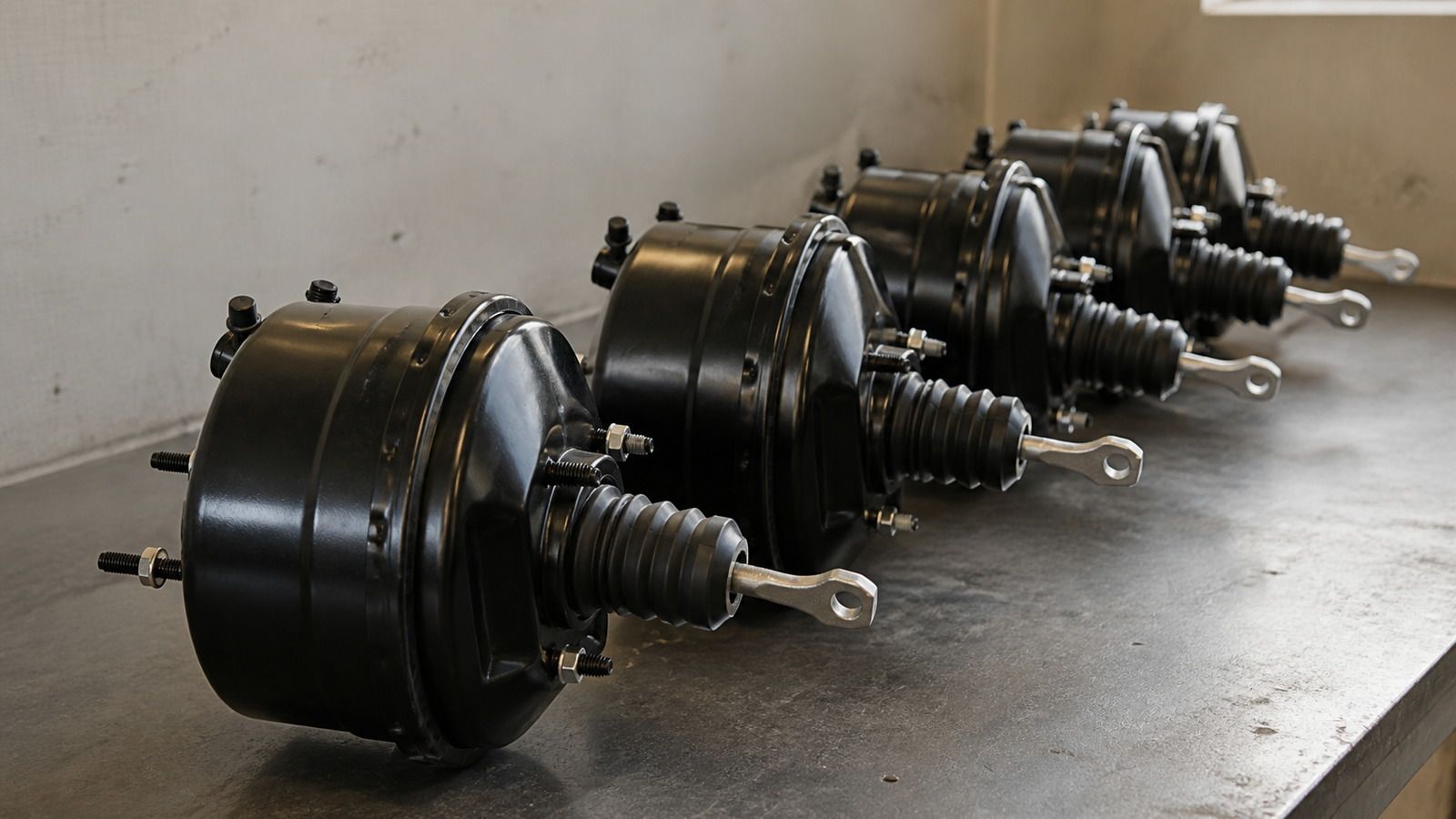
5. From 50 Suppliers to 5: The Shortlisting Checklist
Now consolidate. Everything above (platform badges, exhibitor lists, cluster addresses, OE data) feeds one spreadsheet of names. Expect 30 to 50. Four criteria cut it to 5 in about a week:
| Criterion | What to check | Pass looks like | Fail looks like |
|---|---|---|---|
| Category focus | Product range on their own site, not the platform storefront | Brake hydraulics only: boosters, master cylinders, wheel cylinders | Brake pads + filters + body kits + phone holders |
| Capacity fit | Plant size, part numbers in production, staff count | Your annual volume is meaningful to them, but not most of their output | A 20-person shop for a 100k-unit program, or a giant where you're a rounding error |
| Export markets | Where they already ship | Names your region; knows your labeling and logistics norms | "We export worldwide" with no specifics |
| Response quality | Your test question from Section 1 | Technical answer within ~24h, from someone who clearly knows the part | Price-first replies; "let me check" that takes three days |
Buyers get capacity fit wrong in both directions: too small a factory and your growth breaks them; too large and your emails sink to the bottom of a queue built for OEM programs. The sweet spot is a factory where your account matters but your volume is routine.
On export markets: a factory already shipping to your region has absorbed the expensive lessons. Documentation, packaging, port logistics, claims behavior. AODA's published profile lists six market regions (North America, Central and South America, Southeast Asia, the Middle East, North Africa and Europe), and each one had a first-year learning curve. You want a supplier whose learning curve happened on someone else's order.
Remember Marcus from the intro? Working the screens in order (category focus first, then one technical question, then the legal entity) took him from an unusable list to a short one he could actually travel to. That is the whole point of screening: not to be right about every supplier, but to spend your flight budget on the few worth visiting.
One boundary: shortlisting is not verifying. A surviving name has earned verification, not passed it. Licenses, IATF 16949 certificates, and factory audits are a separate discipline. Shortlist in hand? Here's how to verify each factory before any money moves.
6. Why You Can't Trust "Top 10 Brake Booster Manufacturers" Listicles
Search "top brake booster manufacturers in China" and you'll find confident rankings. Before believing any, ask three questions:
- Who wrote it? In this niche, most Top 10 lists are published by manufacturers, and by remarkable coincidence, the publisher always ranks in the top three. That's not research; it's an advertisement wearing a list's clothes.
- What's the methodology? No test data, no audit results, no disclosed criteria. Just adjectives. A ranking without a method is an opinion.
- Who paid? Directory sites openly sell placement. If the list lives on a site whose business is listing companies, assume the order was negotiable.
We could write one of these lists ourselves and rank ourselves number one. We're not going to. Partly because you'd be right to distrust it, partly because everything verifiable about us is already in this article and on our site.
None of this makes listicles useless. It makes them lead lists. Mine them for names you haven't seen and run each through Section 5 like any other candidate. The moment a "Top 10" article becomes your conclusion instead of your starting point, you've outsourced your due diligence to someone's marketing department.
7. Before You Release the Purchase Order
Verification tells you the factory is real. It doesn't tell you the order will go well. The gap between "we've approved this supplier" and "we've placed the order" is where most first-time China programs actually lose money, and almost none of it is about finding the wrong factory.
Work through this before the PO leaves your desk.
The specification pack. What kind of reference number you're quoting against, the vehicles and markets it serves, the dimensions that must not drift (pushrod length, shell diameter, port orientation, thread and stud pattern), performance requirements, labelling and packaging, your volume forecast, and either a drawing or a physical sample. Every ambiguity you leave here becomes a claim later.
Samples and the approval standard. Ask for production-intent samples, made on production tooling, not hand-built demonstrators. Write down what "approved" means before they arrive: which dimensions get measured, on what equipment, against what tolerance, and who signs. Keep a retained golden sample on both sides. Then agree in writing that mass production must match it.
The quality agreement. This is the document that decides who pays when something goes wrong, and most buyers skip it. It should name the critical characteristics, the control plan and inspection methods, calibration and gauge capability, traceability level, the notification requirement before any material, process or sub-supplier change, containment and sorting duties, and a response deadline for a formal corrective-action report.
Commercial terms. Name the Incoterms edition and the exact place, not just three letters. Define the payment trigger precisely: goods ready, inspection release, or copy documents are three different risk positions. Settle who owns any tooling you pay for, who holds the drawings, and who is responsible for documents and freight if something has to be re-shipped.
Packaging and export. Rust prevention for a machined casting crossing an ocean, individual unit protection, carton strength, palletisation, fumigation and ISPM-15 where wood is involved, country-of-origin marking, and carton-level batch marking so a problem can be isolated to a shipment rather than an entire year.
Claims and after-sales. Define what counts as a defect, what evidence you must supply, and what remedy applies: replacement, credit, or rework. Agree who pays international freight on a warranty return, whether labour is in scope, how a suspect batch gets contained, and how fast the supplier has to respond.
Import responsibility. Decide which entity is the importer of record and who carries product liability insurance in your market. In the United States, a foreign manufacturer of motor-vehicle equipment is required to designate a US agent for service of process (NHTSA), and manufacturers and importers of motor-vehicle equipment can carry safety-defect notification and free-remedy obligations even where no single FMVSS test applies to the specific part. How that lands on your particular product and corporate structure is a question for a US attorney, not for a supplier's sales team, and the time to ask is before the first container, not after.
None of this is exotic. It is the ordinary paperwork of buying a safety part from another continent, and a factory that has done it before will recognise every item on the list. That recognition is itself one of the better signals you'll get.
Conclusion: Finding Is a Funnel, Not a Search
Finding brake booster manufacturers in China was never a search problem. It's a funnel problem. Platforms give you names and badge-level filters. Exhibitor lists give you self-selected, export-serious candidates. The Zhejiang cluster map tells you where the brake hydraulics ecosystem actually lives. An OE number reverse-lookup separates engineering depth from storefront depth in one email. And four criteria (category focus, capacity fit, export markets, response quality) cut 50 names to 5 in a week of desk work.
Your next step is concrete: take one OE number off the part in front of you and run the Section 4 reverse-lookup today. You'll have a working candidate list by tonight.
And if brake boosters, master cylinders, or hydraulic boosters are on your RFQ, start with us, and hold us to every standard in this article. Send us your OE number or browse 1,000+ models in our catalog; fitment confirmed against 2,334 unique reference numbers. For verification, samples, MOQ, payment terms, and inspection, see the full sourcing workflow.
FAQ
Is Alibaba a reliable place to find brake booster manufacturers in China? Yes. As a starting filter, not a conclusion. Use the Verified Supplier filter, check years on platform, search by OE number rather than product name, and read the supplier's own website for category focus. Badges tell you what was checked; your screening tells you whether they make your part.
Where are brake booster manufacturers concentrated in China? Brake hydraulics concentrate in southern Zhejiang's coastal corridor: Yuhuan and Wenling (under Taizhou) and Rui'an (under Wenzhou). Yuhuan alone hosts 4,000+ auto parts manufacturers and is officially recognized as a national auto parts export base. An address in this corridor is a genuine screening signal. The component supply chain and experienced labor are local.
Do I need to attend Chinese trade shows in person to use them for sourcing? No. Exhibitor lists for Automechanika Shanghai and the Canton Fair are published publicly; mining them produces a pre-filtered lead list for free. Attending adds face-to-face assessment, but the list itself is the asset.
How many brake booster suppliers should I contact before choosing one? Start wide: 30 to 50 names from platforms, show lists, and OE searches. Then screen down to about five on category focus, capacity fit, export markets, and response quality. Deep-verify your top two or three before placing a first order.